




Skip to content

Enterprise DAM

Manage all your digital assets in one platform built for complex organizations. Control metadata, rights, workflows and distribution across teams, markets and channels.

Extensions of QBank DAM

Extend QBank to match how your organization works. Add automation, templates, portals and custom functionality when you need it.

Connectors & integrations

Connect QBank to the tools your teams already use. From creative tools and CMS platforms to marketing and product systems.

QBank-menu-news
Share assets beyond your organization

Create branded portals where partners, distributors and teams can easily find and download the right assets.

No outdated files. No endless email threads.

QBank DAM for enterprise organizations

Built for complex organizations that need more than asset storage. QBank helps teams across departments, markets, and industries manage, control, and activate digital assets from one governed source.

QBank-manufacturing-menu-rounded-1
Made for manufacturing complexity

Support product communication, technical documentation, and partner access across global teams, product lines, and systems.

QBank-medtech-menu-rounded-600
Built for medtech compliance

Keep digital assets controlled, traceable, and accessible across regulated workflows, teams, and external audiences.

QBank-retail-menu-rounded-1
Designed for retail speed

Help teams manage and distribute approved campaign, product, and brand content across channels, markets, and seasons.

Built for real content workflows

Explore how QBank supports the workflows that matter most across teams, markets, and systems.

Use case - Manage product content across markets
Manage product content across markets

Give global and local teams one structured way to manage approved product content, adapt it for market needs, and keep it consistent across channels.

Use case - Ensure compliant asset versioning
Ensure compliant asset versioning

Keep approved assets under control with clear version history, structured approvals, and traceability across regulated teams and systems.

Use case - Distribute approved content across systems and channels
Distribute approved content across systems and channels

Distribute approved content across websites, platforms, and downstream environments from one controlled source.

Use case - Reduce duplicate assets and improve content reuse
Reduce duplicate assets and improve content reuse

Centralize approved assets, reduce unnecessary duplication, and make it easier to reuse content across teams, systems, and channels.

Use case - Automate content production
Automate content production

Automate repetitive production tasks and keep content work moving faster across teams and workflows.

Sofie Samrell08-02-20182 min read

The power of an open API

In a time where integrations are key to building efficient Martech stacks, an open API is a necessity. But what is an API and why is it important? We will update you! 

When building efficient Martech stacks, integrations are necessary for efficiency. To make that possible, an open API is a must. Since QBank has an open API, we or those in access to it, can build almost any kind of integration to us.

What is an API?

In the simplest terms, APIs are sets of requirements that govern how one application or web service like QBank can talk to another. You might have used an app on your smartphone that you can login to using your Facebook account? That was made possible using an API. APIs are not only used for logging people into their favorite smartphone games, they can also be used to share information between two systems or even post data from one system into another system. Like reading your friends list or sending those annoying game invites. 

Why is an API important?

Most companies today (large or small) are running their business using a multitude of applications and services. They might use one for accounting, another for CRM and yet another for project management. The need to tie these systems together is becoming more and more important. APIs are a way to do just that throughout your entire organization. The better the API, the more you can integrate the systems and run your business more efficiently.

The technical stuff

We decided to use a RESTful API for QBank, we lean towards using JSON for data exchange but we are nice enough to give you XML as an option too. Authentication is made using OAuth2 Resource Owner Password Credentials or Authorization Code depending on the implementation.

Efficient MARTECH STACKs

Today QBank has more than 30 accessible integrations, all made possible thanks to open APIs. Below is a selection of QBank's connectors.
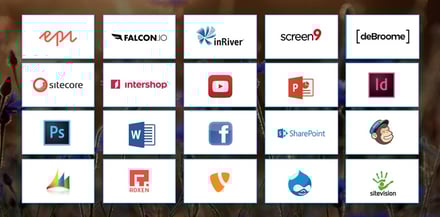
QBank Integrations

QBank's API is used in image pickers that integrate into CMS like WordPress, Optimizely (formerly Episerver) and Drupal or used to pick images to your PowerPoint presentation, InDesign or Word document and more.

Our API is also used to create public image banks (see Image Bank Sweden for example) or used to fetch images in the right size for the Scan recipe bank.

Our client Dometic Group, has built a great solution with QBank as their hub. They've integrated QBank to Sitecore, InDesign, YouTube and inriver PIM.


avatar
Sofie Samrell
QBank's Marketing Manager since early 2016. Sofie has a passion for marketing, communications, and of course, DAM.

RELATED ARTICLES