






-1.png?width=400&name=CMS%20(23)-1.png)

This week, my colleagues and I had the opportunity to attend the 2024 PIMpoint event by Inriver in Malmö. Among the many insightful presentations, one that stood out was from Ntara, a consulting and systems integration firm. They presented a compelling report (sponsered by Inriver) based on their research on US manufacturing and digital commerce maturity. Interestingly, a quick survey of the audience in Malmö indicated that these findings might also apply to the European market. The key takeaway? Companies that focus not only on bottom-line efficiency but also on top-line growth when implementing Product Information Management (PIM) and Digital Asset Management (DAM) systems are more likely to release value early from their investments.
The Shift from Bottom-Line to Top-Line Focus
Traditionally, the drivers for adopting PIM and DAM have been centered around bottom-line savings—streamlining processes, reducing errors, and enhancing efficiency. However, Ntara's research highlighted that businesses aiming to lead in digital commerce need to adopt a broader perspective. By integrating PIM and DAM into a more comprehensive Product Experience Management (PXM) strategy, companies can unlock substantial top-line growth.
Advanced Users vs. Foundational Users
The report identified two distinct groups of users: Advanced Users and Foundational Users. Advanced PIM Users prioritize syndication and enhanced marketing capabilities, focusing on bringing more products to market. Similarly, Advanced DAM Users look beyond mere storage, utilizing DAM for syndication, enhanced marketing, and rights and licensing management. These advanced users typically report higher company performance and greater digital maturity.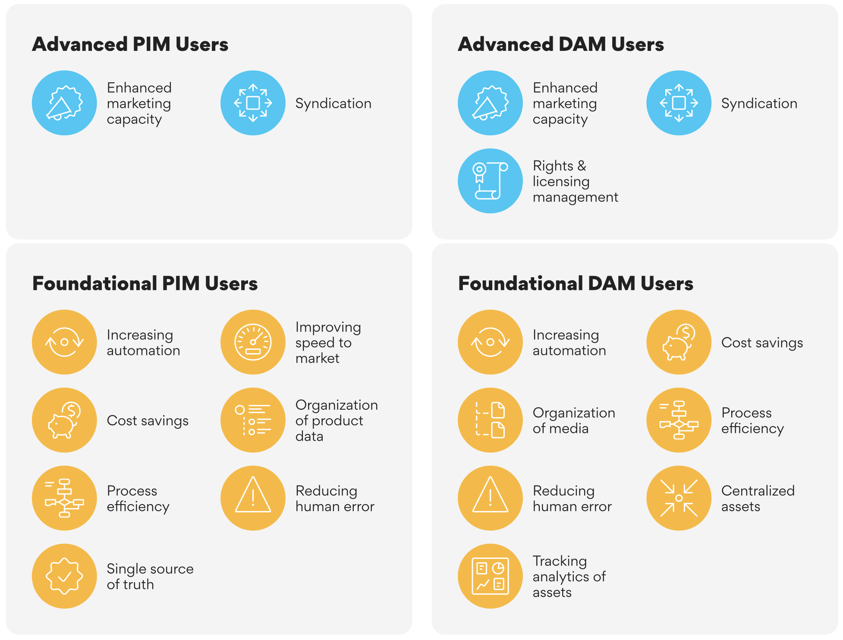 Source: Ntara Report: 2024 US Manufacturers Digital Commerce Benchmarking Study
Importance of Digital Maturity
Ntara's findings underscored the correlation between digital maturity and company performance. Companies with higher levels of digital maturity reported more positive outcomes, reinforcing the idea that sophisticated use of PIM and DAM contributes to overall success. This maturity involves continuous analysis, feature iteration, and change management, which are essential for maintaining a robust digital commerce strategy.
Breaking Down Departmental Silos
A critical factor for success is the cross-functional collaboration within companies. Advanced PIM and DAM businesses train their teams across product, ecommerce, marketing, and IT to work together seamlessly. This collaboration ensures that product data is enriched and maintained accurately, breaking down silos and fostering innovation and growth.
Investing in Expertise and Leadership
The most digitally mature companies understand the importance of investing in top management expertise to drive growth through PIM and DAM tools. These leaders see beyond the foundational functionalities and recognize the potential for PIM and DAM to scale businesses into new channels, enhance product experiences, and adapt to new challenges and regulations quickly.
Implications for the Future
The insights from Ntara's research highlight a clear divide in the implementation drivers for PIM and DAM. Companies that view these tools purely as efficiency enablers are missing out on significant growth opportunities. In contrast, those that adopt a holistic PXM strategy, emphasizing top-line growth, are poised to become leaders in digital commerce.
The Role of QBank
Platforms like QBank offer a comprehensive solution that supports both foundational and advanced needs. QBank enhances marketing capacity, manages rights and licensing, and enables syndication. This makes it a powerful tool for businesses aiming to excel in digital commerce.
To sum up, the key takeaway is clear: Investing in top management expertise to drive growth through PIM and DAM is crucial. Companies that embrace this approach will see faster returns and become digital commerce leaders, ready to thrive in an ever-evolving market.
The themes from Ntara's presentation at PIMpoint emphasize focusing on growth, investing in digital maturity, and fully leveraging PIM and DAM systems. I'm excited to follow this development and work with our existing customers and potential new ones on DAM solutions that not only target efficiency but also support growth and the bigger picture.
Book a demo or talk to a DAM expert to learn more about how QBank can help you excel in digital commerce.