



-1.png?width=400&name=CMS%20(23)-1.png)

Why DAM has to become infrastructure for AI-ready, governed enterprise content.
From marketing library to enterprise content infrastructure
AI is changing the scale and speed of content creation. But it is also highlighting something many organisations have struggled with for years: content is only useful when you know what it is, where it belongs and how it can be used.
When assets are spread across drives, systems and portals, with inconsistent metadata and unclear ownership, adding AI does not solve the underlying problem. In many cases, it makes it more visible.
AI can generate, search and reuse content faster than ever. But for organisations to trust the result, the content behind it needs context.
Which version is approved?
Where can this image be used?
Which market does it belong to?
Has it expired?
Who owns it?
Can an AI tool use it?
This is where the role of DAM is starting to change.
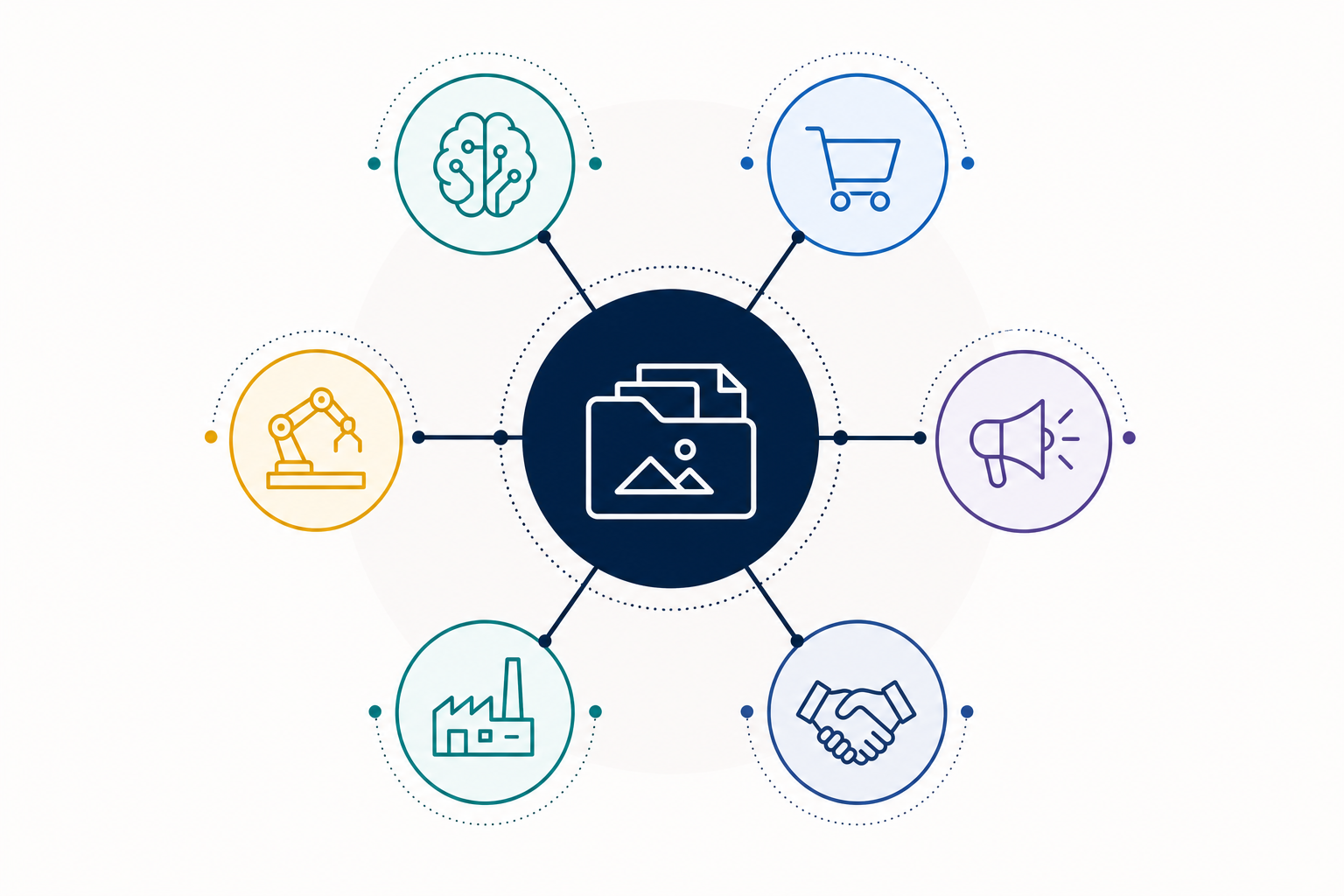
Rather than being a library primarily used by marketing teams, DAM can become a shared content foundation across the organisation: a place where assets, metadata, rights, approvals and relationships are managed consistently.
That foundation becomes increasingly important as more systems and AI tools depend on content.
A modern DAM helps organisations:
- Bring important brand, product and business content together.
- Add context through metadata such as products, markets, rights, audiences and lifecycle.
- Control which content is approved and where it can be used.
- Connect governed content to CMS, PIM, ecommerce, portals and other systems.
The value is not simply having everything in one place.
It is knowing which content can be trusted and making that content available where it is needed.
For AI, that difference matters. Instead of searching across disconnected sources with different levels of quality and control, assistants and agents can work with content that has a known context, owner and status.
DAM becomes less about storing assets and more about helping trusted content move through the organisation.
DAM as part of a connected content ecosystem
Thinking about DAM as infrastructure also changes how it should be designed.
Content ecosystems are becoming more distributed, not less. New channels, platforms and AI services will continue to appear, and organisations need to be able to connect them without rebuilding their content operations every time.
That makes openness increasingly important.
APIs, integrations and events allow DAM to work as part of a wider ecosystem rather than as another isolated platform.
The DAM does not need to own every piece of information. But it should have a clear role.
PIM may own product data.
CMS manages digital experiences.
Business systems manage customers, products and processes.
DAM adds the content layer: the assets themselves together with the metadata, permissions, rights and governance needed to use them correctly.
Connecting these systems creates something much more useful than another central repository.
For example, product information from PIM can give an asset additional context. DAM can then manage the approved imagery, documents or videos connected to that product and make them available to websites, ecommerce platforms, partners or AI tools.
The same principle applies to AI.
Rather than creating a separate content source for every assistant or AI initiative, organisations can allow AI tools to consume governed content from the existing ecosystem.
Metadata can then help AI understand not only what an asset contains, but also how it should be used.
That might include:
- usage rights
- market or language
- product relationships
- approval status
- audience
- expiry dates
- AI-generated or AI-assisted content
- review or disclosure requirements
Governance becomes something that can be acted on by systems and workflows, rather than something described in a policy document.
And that is an important shift.
Scaling AI without losing control
As AI becomes easier to use, more people and systems will interact with enterprise content.
The question will increasingly move from:
Can AI find this?
to:
Should AI use this?
Imagine an employee asking an internal assistant:
Can I use this product image in a campaign in Germany?
Answering that question properly requires more than image recognition or semantic search.
The system may need to understand the product, market, rights, approval status, expiry date and perhaps even whether the asset has been generated or modified using AI.
That context already exists in many organisations, but often across several different systems or processes.
A connected DAM can help bring those signals together around the asset.
This creates a stronger foundation for both people and AI.
Organisations can, for example:
- Make approved content available to AI-powered tools.
- Use metadata to guide which assets should be used for different markets, audiences or channels.
- Apply governance rules before content is distributed.
- Trace where assets come from and how they are being used.
- Connect new AI capabilities without rebuilding the underlying content structure.
The goal is not to put everything into the DAM.
It is to make the content that matters easier to trust, govern and activate across the organisation.
For QBank, this is a natural evolution of DAM.
From managing assets to managing the context around them.
From isolated libraries to connected content ecosystems.
From helping people find content to helping content move safely into workflows, systems, channels and AI.
Because as content volumes grow, the organisations that get the most value from AI will not simply be the ones that create more content.
They will be the ones that know which content they can trust and can put it to work.