






Five practical ideas for making your content work harder, without making your marketing team work harder from global manufacturer ITT.
A new product image arrives. Marketing updates the website. Someone sends it to the sales team. Another person uploads it to the partner portal. And somewhere, an old version is still sitting in a PowerPoint presentation.
Sound familiar?
Now imagine managing that across 23 product brands, 8,000 employees and more than 3,000 distributors and channel partners. That's the scale ITT Flow Technologies operates at.
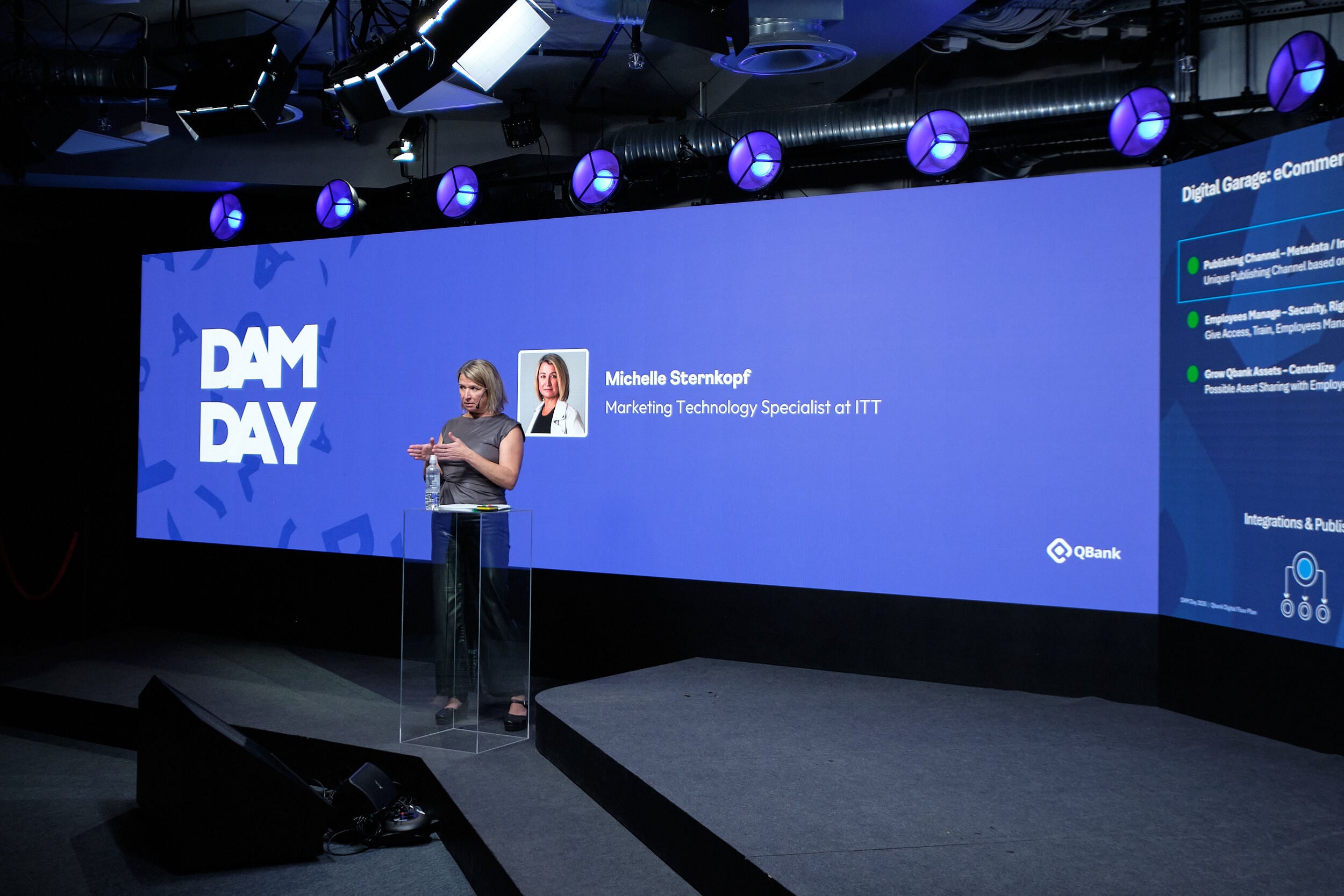
At DAM Day 2026, Michelle Sternkopf, Marketing Technology Specialist at ITT, shared how the global manufacturing company has built a connected content ecosystem around QBank.
Today, five different platforms are connected to the same Digital Asset Management (DAM) system, helping teams access approved content wherever they work. And the business benefits go well beyond keeping files organized.
Here are five ideas worth borrowing for your own content operations.
1. Your next rebrand shouldn't require updating five different platforms
A rebrand is exciting. At least until someone starts counting how many places the old logo lives.
Websites. Sales presentations. Partner portals. Product images. Internal documents.
For a global organization, keeping everything consistent can quickly become a major undertaking. When ITT announced a company-wide rebrand in July, it needed to make updated logos, product imagery and icons available to employees across the business.
Fortunately, ITT had already connected QBank to several of the platforms its teams use every day. Instead of managing separate asset libraries, ITT could update assets in QBank and make the latest approved versions available through connected platforms, including its website, secured Media Hub and Templify, its sales presentation tool.
Sales teams could then access updated visuals directly in Templify when creating presentations, rather than searching for and downloading files separately.
One place to manage assets. Multiple places to use them.
The real advantage isn't just a faster rebrand. It's knowing that the people representing your brand have access to the right content.
Try this
Think about your last major campaign, product launch or rebrand.
How many platforms needed updated assets? How many people were involved in distributing them? And how many times did someone have to download and reupload the same file?
Those are your opportunities to make the next launch easier.
2. Your metadata could save you hundreds of hours a year
Metadata might not be the most exciting topic at your next marketing meeting.
But what if better metadata could give your team hundreds of hours back?
That's exactly what ITT experienced. Its product pages contain downloadable sales materials, technical documentation and 2D and 3D drawings. Previously, website administrators had to manually locate and add those documents to the relevant pages.
Now, QBank and ITT's website CMS share metadata such as brand, product type, subtype and product series. When a new document is correctly tagged and published in QBank, it automatically appears in the download section of the appropriate product page.
No manual upload to every page required.
The result? Hundreds of hours saved annually for ITT's website team.
And this is where structured metadata starts delivering measurable business value. For a manufacturer managing thousands of products, or a retailer launching hundreds of new items every season, the potential is significant.
Try this
Identify a repetitive content task that your team performs every week.
Maybe it's uploading product images, adding technical documents to webpages or organizing campaign material for different markets.
Then ask: could a shared product ID, category or metadata field tell another system where that content belongs?
Sometimes the biggest efficiency gains come from automating the smallest tasks.
3. Your partners should never have to ask for the latest logo
When you work with hundreds or thousands of distributors, franchisees, resellers or retail partners, brand consistency becomes a shared responsibility.
But not every partner needs access to every asset.
ITT's distributors, for example, are authorized to sell specific product brands in specific regions.
Using QBank's metadata, access rights and single sign-on integration, ITT created a secured Media Hub where partners can access the content relevant to them.
Brand and regional permissions help determine which assets each partner can see. So rather than distributing files manually or maintaining separate content libraries for every partner, ITT can make approved assets available through one connected system.
For marketers, that means more control over how the brand is represented. For partners, it means easier access to the materials they need to sell. And for customers, it helps create a more consistent brand experience.
Try this
Look at how your external partners receive marketing materials today.
Do they have to request files? Are assets distributed by email? Can they easily identify the latest approved version?
Consider whether a permission-based content hub could make life easier for everyone.
4. Marketing doesn't need to be involved in every upload
Here's an interesting question: What if giving more teams access to your DAM actually gave marketing more control over its content?
At ITT, the e-commerce team needed product images and technical documentation for its SAP Hybris platform. Rather than having marketing manage every asset on their behalf, the team received permission to upload and manage its own content in QBank.
Each spare-part image could be tagged with its SAP material number, making it easier to connect the right assets to the right product pages.
And something interesting happened. As the e-commerce team added spare-part imagery, those assets became available for other purposes too. Marketing could now find the exact O-ring or seal kit needed for an aftermarket campaign, without having to source the image again.
One team's content became another team's resource.
It's a great example of how a DAM can help different departments work independently while contributing to a shared content library.
Try this
Identify the teams that regularly create or manage content outside marketing.
Could product management, e-commerce, engineering or regional teams contribute their own assets to a shared system?
With clear permissions and metadata requirements, you can give teams more independence without losing oversight.
5. Build your content ecosystem for the company you're becoming
Businesses don't stand still.
They acquire brands, enter new markets, migrate websites and introduce new platforms.
And every change creates new demands on content operations. When ITT first implemented QBank, it was migrating its website from Tridion to Umbraco. By mapping existing asset metadata into QBank, the team moved thousands of assets over a single weekend, a process that could otherwise have taken weeks.
Now, ITT is preparing another CMS migration, this time to Kentico, along with the addition of eight more brands' assets. The same content foundation is designed to support that next stage of growth.
And the team isn't stopping at its current five connections. Future plans include integrating QBank with HubSpot, Canva and Adobe tools to make approved assets even easier to access in everyday marketing workflows.
The lesson? Don't build your content operations around the platforms you happen to use today. Build them to connect with the platforms you'll need tomorrow.
Try this
Look at your technology roadmap for the next 12 to 24 months.
Are you planning a new e-commerce platform, marketing automation tool, website migration or acquisition?
Consider how each will access and use your existing digital assets.
The earlier you think about those connections, the easier it becomes to scale your content operations as the business grows.
Less file management. More actual marketing.
Perhaps the most interesting thing about ITT's story isn't the number of platforms connected to QBank.
It's what those connections make possible. Website teams spend less time uploading documents. Sales teams can access approved visuals. Distributors find the content they're authorized to use. E-commerce teams manage their own assets. Marketing can reuse content created across the business.
All without having to maintain separate libraries for every platform and department.
And that brings us back to a simple idea:
Your marketing team has better things to do than upload the same image five times.
With the right structure and integrations, your content can work harder without your team having to.
Watch the full keynote
Want to see how ITT connects its content ecosystem? Watch Michelle Sternkopf's presentation from DAM Day 2026 here: https://qbankdam.com/dam-day-26
Curious about building more connected content operations? Explore QBank's Digital Asset Management platform.