Why DAM RFP preparation matters
Choosing a DAM is not just about finding a platform with the right features.
It is about understanding how your organization creates, manages, approves, finds, shares and activates digital assets across teams, systems, markets and channels.
A strong DAM RFP should reflect how your business actually works. That means looking at your workflows, users, content types, metadata, integrations, governance needs and future growth before you compare vendors.
When this preparation is done well, your RFP becomes more than a procurement document. It becomes a practical foundation for choosing a DAM that can create value over time.
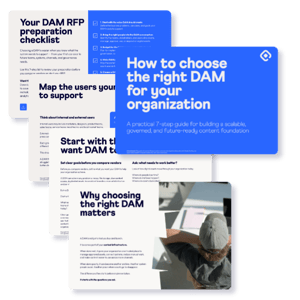
The full guide walks you through a 7-step framework for preparing your DAM RFP before vendor comparison begins.
What makes a DAM RFP useful?
A useful DAM RFP does more than ask whether a vendor has certain features.
It explains what the DAM needs to support in practice.
That includes your most important use cases, the teams and users who depend on digital assets, the systems DAM needs to connect with, the metadata and governance rules that need to be in place, and how success will be measured.
A stronger RFP gives vendors the context they need to show how their solution would support your real workflows.
It also makes it easier for your internal teams to align on what matters most: business value, control, scalability and long-term fit.
Why your DAM RFP should start with use cases
Many DAM RFPs start with a long feature list.
That can be useful, but it is rarely enough.
A better starting point is to define where digital asset workflows slow down today. Are teams struggling to find approved content? Are assets duplicated across systems? Are product assets disconnected from product data? Are sales, service or partner teams dependent on manual requests?
Use cases help you describe what DAM should solve.
They also help vendors show how the DAM would support real workflows, not just whether a feature exists.
A use case-driven RFP makes it easier to choose a DAM based on value, not assumptions.
What should you define before comparing DAM vendors?
Before you compare DAM vendors, you should be able to explain what your DAM needs to support.
That includes your key business use cases, the teams involved, the systems that need to connect, and the rules that determine how assets should be managed and used.
You should also define how content moves today: where assets are created, where metadata is added, where approvals happen, where content is published and where manual work creates friction.
This preparation helps you move beyond storage and search.
It helps you define DAM as a content foundation for the organization.
The guide gives you the full framework for doing this step by step.
Why DAM requirements need to cover the full content ecosystem
A DAM should not become another isolated library.
In many organizations, digital assets are created, enriched, approved, published and reused across several tools and channels. Assets may connect to PIM, CMS, e-commerce platforms, ERP, CRM, portals, sales tools, partner channels or internal systems.
Your DAM requirements should reflect that ecosystem.
Think about where assets come from, where they need to go, which systems depend on them, and how approved content should stay consistent across channels.
When DAM becomes part of your content ecosystem, it can reduce duplication, improve governance and help teams activate content without losing control.
Why metadata and governance belong in the RFP
Metadata is what makes a DAM useful.
Governance is what makes it trustworthy.
Together, they help users find the right assets, understand how they can be used and trust that content is approved, current and compliant.
Your RFP should define the metadata and governance requirements your DAM needs to support. This may include search fields, approval status, usage rights, market or channel restrictions, consent, expiry dates, version control, audit trails and AI-related content information.
Leaving this until implementation can create unnecessary complexity later.
A strong RFP makes metadata and governance part of the decision from the start.
Why scalability should be part of your DAM decision
Your first DAM use case may be clear.
But your future needs will grow.
More teams may join. More systems may connect. More markets, languages, channels, asset types and governance rules may appear over time.
That is why scalability should be part of the RFP from the beginning.
Scalability is not only about storage or user numbers. It is also about whether the DAM can support evolving metadata, permissions, workflows, integrations, portals, APIs and reporting needs.
The right DAM should support your first phase, but also make future growth easier.
How the guide and checklist work together
The DAM RFP Guide and DAM RFP Checklist support different parts of the same process.
The guide helps you prepare internally. It gives you a 7-step framework for defining use cases, stakeholders, budget, integrations, scalability, metadata, governance and success metrics before you compare vendors.
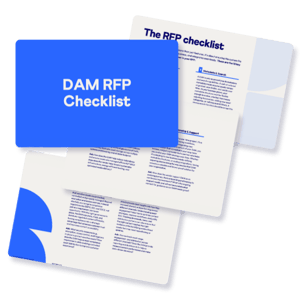
The checklist helps you turn that preparation into practical RFP questions. It covers 10 key vendor areas, including business needs, metadata, migration, scalability, integrations, AI, security, analytics, sustainability and vendor support.
Use the guide to understand what your DAM needs to support.
Use the checklist to make your vendor evaluation more complete.






-1.png?width=400&name=CMS%20(23)-1.png)


.png?width=60&name=building-2%20(4).png)
.png?width=60&name=shield-check%20(10).png)
.png?width=60&name=layers%20(10).png)