Skip to content

Enterprise DAM

Manage all your digital assets in one platform built for complex organizations. Control metadata, rights, workflows and distribution across teams, markets and channels.

Extensions of QBank DAM

Extend QBank to match how your organization works. Add automation, templates, portals and custom functionality when you need it.

Connectors & integrations

Connect QBank to the tools your teams already use. From creative tools and CMS platforms to marketing and product systems.

QBank-menu-news
Share assets beyond your organization

Create branded portals where partners, distributors and teams can easily find and download the right assets.

No outdated files. No endless email threads.

QBank DAM for enterprise organizations

Built for complex organizations that need more than asset storage. QBank helps teams across departments, markets, and industries manage, control, and activate digital assets from one governed source.

QBank-manufacturing-menu-rounded-1
Made for manufacturing complexity

Support product communication, technical documentation, and partner access across global teams, product lines, and systems.

QBank-medtech-menu-rounded-600
Built for medtech compliance

Keep digital assets controlled, traceable, and accessible across regulated workflows, teams, and external audiences.

QBank-retail-menu-rounded-1
Designed for retail speed

Help teams manage and distribute approved campaign, product, and brand content across channels, markets, and seasons.

Built for real content workflows

Explore how QBank supports the workflows that matter most across teams, markets, and systems.

Use case - Manage product content across markets
Manage product content across markets

Give global and local teams one structured way to manage approved product content, adapt it for market needs, and keep it consistent across channels.

Use case - Ensure compliant asset versioning
Ensure compliant asset versioning

Keep approved assets under control with clear version history, structured approvals, and traceability across regulated teams and systems.

Use case - Distribute approved content across systems and channels
Distribute approved content across systems and channels

Distribute approved content across websites, platforms, and downstream environments from one controlled source.

Use case - Reduce duplicate assets and improve content reuse
Reduce duplicate assets and improve content reuse

Centralize approved assets, reduce unnecessary duplication, and make it easier to reuse content across teams, systems, and channels.

Use case - Automate content production
Automate content production

Automate repetitive production tasks and keep content work moving faster across teams and workflows.

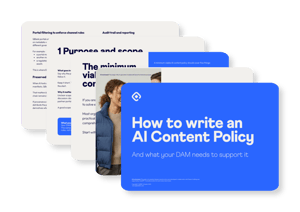
How to write an AI content policy

AI-generated content requires clear processes for disclosure, approval, traceability, and distribution.

In this guide, you'll learn how to build an operational AI content policy and what your DAM needs to support compliance, governance, and content traceability.

This guide is for marketing teams, DAM managers, content operations teams, and governance owners navigating the EU AI Act and AI-generated media governance.

notebook-text
24-page practical guide
A practical framework for building AI content governance that works in real content operations, not just in policy documents.
building-2 (4)
Built for enterprise content operations
Created for DAM managers, marketing teams, governance owners, and organizations handling AI-generated content across multiple channels and teams.
shield-check (10)
Gives context on AI disclosure and governance
Explains key governance questions around AI-generated content, including disclosure, transparency, approval, and traceability.
layers (10)
Shows how the DAM can support governance
Looks at the DAM capabilities that help turn policy into practice, from metadata and approvals to provenance, audit trails, and channel control.

AI governance starts in the DAM, not the AI tool

Most conversations about AI-generated content focus on the tools themselves. Which tools support C2PA. Which tools add watermarks. Which providers will comply with the EU AI Act. Those questions matter. But they are only one part of the picture. The bigger challenge starts after the content leaves the AI tool.

Once an AI-generated asset is downloaded, uploaded to a DAM, edited, approved, distributed across channels, and published, the operational questions begin.

  • Who tracks the AI involvement?
  • Who decides whether disclosure is required?
  • Who confirms the rules were followed?
  • Who can prove how the asset was handled six months later?

That work does not happen inside the AI tool. It happens in the content infrastructure around it. This is why AI governance starts in the DAM. The AI tool creates the content. The DAM governs it.

Why AI content governance matters now

AI changes content operations in ways traditional governance models were never designed for.

Traditional content has a clear chain of custody

With traditional content, the chain is usually clear. You know who created the asset, where it came from, when it was approved, and how it was distributed.

AI complicates that process

An image may be generated from a prompt. A voiceover may be synthetic. A video may depict something that never happened. A document may be partially written by AI and then edited by a person.

That creates new governance questions around disclosure, approval, traceability, and provenance.

  • Is this fully AI-generated or AI-assisted?
  • Can it be used in this channel?
  • Does it require disclosure?
  • Can we prove where it came from?

Governance is becoming a business requirement

From August 2026, parts of this become a legal requirement under the EU AI Act. But the need goes beyond compliance.

AI-generated media introduces operational risk that most content governance models were never built to manage.

An AI content policy gives organizations a way to:

  • Identify AI involvement
  • Apply rules consistently
  • Control distribution
  • Document approvals
  • Maintain traceability

Without that structure, AI content spreads faster than governance can keep up.

What an AI content policy actually does

At its core, an AI content policy does three things:

  • Defines what counts as AI involvement
  • Defines what content can go where
  • Connects policy to operational systems

It defines what counts as AI involvement

Not all AI content is the same.

There is a major difference between:

  • A fully AI-generated campaign image
  • A product photo enhanced with generative fill
  • A document checked with AI writing assistance

The policy creates shared definitions so teams apply the right rules consistently.

It defines what content can go where

Different channels carry different levels of risk.

AI-generated social content is very different from AI-generated regulatory documentation. Internal training material is different from customer-facing healthcare communication.

The policy maps content types to approved channels, approval requirements, and disclosure rules.

It connects policy to operational systems

A policy document alone changes nothing.

Governance only works when the rules connect to workflows, metadata, approvals, audit trails, and distribution controls inside the DAM.

That is what turns policy into operational governance.

Where the EU AI Act fits

The EU AI Act divides AI systems into different risk categories.

Most AI content governance work falls into the limited-risk category. This includes:

  • AI-generated imagery
  • Synthetic video
  • AI-generated audio
  • AI-generated text
  • Deepfakes and synthetic media

The main requirement in this category is transparency. People should understand when they are interacting with AI-generated content.

This creates new operational requirements around disclosure, traceability, provenance metadata, and approval workflows.

This guide focuses on that operational side: how organizations classify, approve, track, and distribute AI-generated content safely across channels and systems.

It is not a legal interpretation of the Act. It is a practical guide to operational AI governance and what your DAM needs to support it.

Guide AI content policy

Download the full AI content policy guide

Everything you need to build, govern, and operationalize AI-generated content across your organization.

✓ The 10 sections every AI content policy needs

✓ Disclosure and approval requirements

✓ AI governance models and ownership structures

✓ Metadata, provenance, and traceability best practices

✓ Channel-specific governance controls

✓ DAM requirements for operational AI governance

Created for DAM teams, marketing operations, and governance leaders navigating the EU AI Act and AI-generated media.

Common questions about AI content governance

What is an AI content policy?

An AI content policy defines how an organization creates, approves, discloses, tracks, and distributes AI-generated or AI-assisted content. It creates shared rules for governance, approval, and operational handling across teams and systems.

Why do organizations need AI content governance? AI-generated content introduces new operational challenges around disclosure, traceability, approvals, and distribution. Without clear governance, organizations struggle to apply consistent rules across channels and teams.
What counts as AI-assisted content? AI-assisted content is human-created content that has been edited or enhanced using AI tools. Examples include generative fill, AI background removal, audio cleanup, or AI writing suggestions.
What is the difference between AI-assisted and fully AI-generated content? Fully AI-generated content is created end-to-end by AI systems. AI-assisted content starts with human-created work that is later modified or enhanced using AI tools.
Does the EU AI Act require disclosure of AI-generated content?

In some cases, yes. The EU AI Act introduces transparency requirements for certain types of AI-generated and synthetic media, especially where people could mistake the content for authentic or human-created material.

What should a DAM system support for AI governance?

A DAM should support structured metadata, approval workflows, audit trails, provenance preservation, disclosure handling, and channel-level governance rules for AI-generated content.

QBank supports this through configurable property sets, approval states, dynamic folders, portal filtering, and audit tracking that help organizations operationalize AI governance across content workflows.

What metadata should organizations track for AI-generated assets?

Most organizations should track:

  • AI involvement level
  • generation tool
  • disclosure requirement
  • approval status
  • provenance or source information
  • approver and distribution history

QBank can manage these through structured metadata fields and governance-focused property sets connected to approval and publishing workflows.

What is provenance metadata?

Provenance metadata records where an asset came from, how it was created, and whether AI was involved. This may include embedded metadata, C2PA manifests, or operational audit information inside the DAM.

QBank preserves embedded metadata on original assets and helps organizations keep provenance information connected to operational workflows. 

How does C2PA relate to DAM governance?

C2PA helps attach provenance information to digital assets. DAM systems play an important role in preserving that metadata, keeping the evidence chain intact, and making provenance information visible during governance and distribution workflows.

QBank helps preserve provenance metadata on original assets and supports governance workflows built around traceability and disclosure. We are also developing ways to read and use this data to support automated tagging and validation, and exploring future support for trusted content modification.

Why does AI governance start in the DAM?

The AI tool creates the content, but governance happens after the asset enters real content operations. Metadata, approvals, disclosure handling, audit trails, and distribution controls all live in the DAM and surrounding content infrastructure.

QBank helps operationalize those controls through metadata governance, approval workflows, auditability, and channel-level distribution rules.

Are you ready to go further?

Start with a digital asset management demo. Whether you’re starting fresh or rethinking what you have, we help you move forward with confidence.